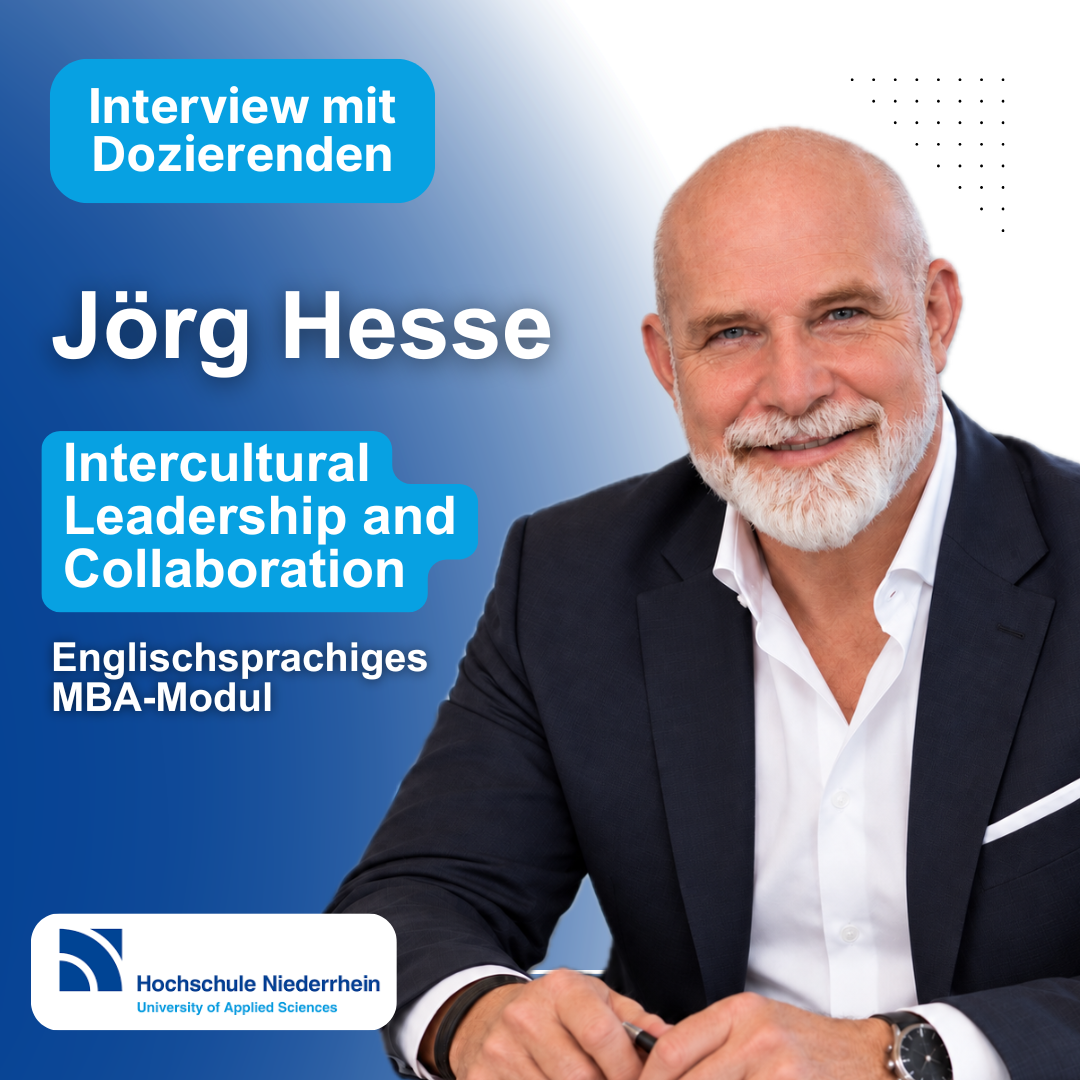
Question 1: Could you briefly tell us about your professional background and how you became involved in intercultural leadership?
After completing a banking apprenticeship, I studied economics and social sciences. I already had an international orientation during my studies and also spent some time abroad. Since starting my career in global industrial companies, my international assignment has been a recurring theme throughout my professional career. Accordingly, I have dealt intensively with cultural issues - from my personal encounters with foreign cultures and out of general interest. As People & Culture Manager and Specialist for Organizational Development at large medium-sized companies, I have made the issue of good leadership and cooperation in an intercultural context a focus of my work for over 25 years now. I therefore pass on both practical and theoretical knowledge in the MBA program.
Question 2: What motivated you personally to focus on intercultural collaboration and leadership in your work with executives?
The Dutch social psychologist Geert Hofstede said: "Culture is more often a source of conflict than of synergy. Cultural differences are a nuisance at best and often a disaster." This was the starting point for his many years of scientific involvement with this topic. A young discipline, but there are now a large number of scientific approaches and patterns of action to reduce the chaos. I am very interested in this because of my business-related experiences.
We have gone through various phases of globalization. The most recent wave of globalization, since the 1990s, is characterized by individual encounters, driven by virtual networking. This (fortunately) brings with it even more intensive encounters between people in the labor context. Personal networking (globalization of individuals) places even greater demands on leadership and collaboration. The cultural influence is becoming even more noticeable and requires more knowledge and experience in intercultural encounters. That's why this topic interests me so much.
Question 3: How did you develop the concept and structure for the “Intercultural Leadership and Collaboration” module in the MBA program?
The module concept pursues a combination of theory and practice. We essentially look at interpersonal verbal and non-verbal communication - this forces us to shed light on practice, analyze it methodically and derive suitable courses of action to ensure that interpersonal communication works well in encounters. The module uses valid models and explanatory patterns such as Hofstede's cultural dimensions, the models and scientific observations of Trompenaars & Hampden-Turner, Edward Hall and Nancy Adler. Within the MBA module, we move interactively through the world of cultural diversity and look for structures that support us in practical leadership and collaboration (and certainly not only there). The module also looks at the experience that the participants already have - after all, they are not beginners.
Question 4: Which core competencies do students acquire through this course?
The primary aim is to bring the concept of national culture to a pragmatic level, to understand what lies behind it and how we can define and understand cultural differences. By comparing cultural characteristics, students gain a better understanding of cultural characteristics and how they can derive suitable ways of acting and behaving in encounters. An important part of this is not only the view of foreign cultures, but also the reflection on how I live my own cultural imprint in relation to other cultures. It‘s all about better mutual understanding for a successful cooperation.
Question 5: What are the biggest challenges managers typically face when working in intercultural environments?
In most cases, these are difficult or, in the worst case, failed attempts to manage professional contacts well and successfully under the influence of foreign national cultures. There are many cultural dimensions that are not known in their manifestation (blind spots) or that others do not know about me (known to me, not to others). This causes interpretations of behavior and actions that clash with my mindset (or with the mindset of the other person). In most cases, this is not addressed openly and appreciatively, leading to a latent, subliminal negative influence on our business contacts. This concerns the personal level and even affects large projects such as mergers and acquisitions. Then everyone will realize: cultural influences are not a side issue. Intercultural competence is an essential component of modern leadership.
Question 6: Could you give an example from your experience where intercultural misunderstandings significantly affected a project or collaboration?
I experienced a German quality manager who had to inspect and approve products in China as part of the sourcing process in the early 2000s. He was regularly visiting suppliers in China and when he was in Germany, he would talk on the phone in his office, which was next to mine, so loudly that I could hear it. He shouted and became aggressive. I asked him if that was the right tone to use with the Chinese. He argued that this was the only way the people there would understand. The projects were always problematic and there were no signs of improvement. It was only when another manager with more sensitivity for German-Chinese communication took over responsibility that the situation improved.
Question 7: How do you address such real-world situations and case studies in your teaching?
The curriculum is basically designed so that the factual and methodological knowledge can be acquired from case studies and practical examples or can be applied with their help. This is perhaps comparable to music or language: it's about communicating according to certain rules and harmonic aspects. You have to play music. You also have to speak a language. The situation is similar with intercultural exchange.
Question 8: This course also covers collaboration in virtual and international teams. What unique skills are needed in these settings?
As already mentioned, we have been experiencing an increase in virtual intercultural encounters since the 1990s. This places enormous demands on communication skills and sensitivity in connection with national cultural characteristics. In virtual meetings, there is usually no body language, which is an essential part of the communicative exchange. Meetings are fast-paced and short-lived. We usually converse in a language that is foreign to everyone involved. So-called micro messages are difficult to understand, the reading and listening between the lines, which is characteristic of a native language. As a leader or project manager, increased sensitivity and knowledge of intercultural collaboration is therefore required. Harmonizing several nationalities in a team is usually a major challenge. It makes sense to sensitize all members of an intercultural team for diversity from the first day on and to establish supervision points in projects or in regular collaboration in order to evaluate the progress of the collaboration and generate learning effects through meta-communication. Managers should take this seriously.
Question 9: How do cultural dimensions like power distance, individualism, and uncertainty avoidance influence leadership styles?
These cultural dimensions—such as power distance, individualism vs. collectivism, or uncertainty avoidance—come from models like Hofstede’s and greatly influence leadership styles.
For example, in cultures with low power distance, the relationship between leaders and teams is close, more collaborative, and less hierarchical. Leaders tend to seek common solutions and promote team participation in decision-making.
In contrast, high power distance cultures maintain a clear separation between leaders and subordinates. Authority is emphasized, and communication is more about giving instructions and following orders.
These dimensions shape not only how leadership is practiced, but also how it is perceived and received by the team. Understanding them helps leaders adapt their style to different cultural contexts more effectively.
Question 10: In your opinion, how can leaders prepare themselves to manage mergers & acquisitions across different cultures successfully?
Take a look at the national cultures behind the companies. How diverse is the new part of the company already set up? Is there already experience from previous international mergers and cooperations or is this new territory for the company? This results in a completely different approach when bringing together two companies with different national cultures. They need a close confidant from the other company with whom they can obtain explanations about culturally determined behavior on a trusting level. This creates understanding and avoids problems that could otherwise cost a lot of money.
Question 11: How do students in the course typically react to the intercultural content? Are there any recurring insights or surprises?
Most participants notice that "culture" suddenly becomes something very tangible, very concrete. A certain structuring leads to solutions that have not been seen before. The indefinable in the concept of culture disappears. Experiences from the students' own everyday working life with intercultural encounters, which previously remained unclear, are suddenly understood in a comprehensible way.
Question 12: What final advice would you give to MBA students who aim to lead effectively in global and diverse environments?
Don't just reflect on how a foreign culture affects you. Develop sensitivity for your own mindset and behavior when interacting with a foreign culture. For example, by asking the representative of a foreign culture how you are received as a foreigner, how you are understood, how you are seen. You will make mistakes or encounter difficulties, that’s part of the game. But don't let this stop you - it is very important for your further development.